
August 10, 2026
How Evidence Generation Improves Clinical Trial Design
"Neurodiscovery AI has been instrumental in transforming real-world neurology data into actionable insights that improve patient care and sustain private practice. Their commitment to neurologists—ensuring both business success and innovation in drug discovery—makes them an invaluable partner to NeuroNet and the entire field of community neurology."
Joseph V. Fritz PhDPartner,
A protocol goes through design review, feasibility assessment, and often two or three amendments before a single patient is enrolled and most of that churn traces back to the same root cause: decisions made without enough evidence at the point they needed to be made. Evidence generation is supposed to close that gap. In practice, for many neurology programs, it still runs on a separate timeline from the protocol it's meant to inform.
Evidence generation: the structured production of clinical evidence from trial data, real-world data, and natural history studies is most valuable when it happens before protocol lock, not after a trial has already missed its enrollment target. This piece looks at what that means in practice: how evidence generation feeds clinical trial design, where the process breaks down today, and what closes the gap between the two.
What Evidence Generation Means for Clinical Trial Design
Evidence generation is the process of producing reliable clinical evidence, efficacy signals, safety profiles, natural history, epidemiology, treatment patterns using structured trial data, real-world data (EHRs, claims, registries), or a combination of both. For clinical trial design specifically, it answers the questions a protocol team needs answered before writing inclusion criteria: how large is the eligible population, what does disease progression look like without intervention, which endpoints are both clinically meaningful and measurable, and which comparator or control strategy is defensible.
Where evidence generation has traditionally been treated as a downstream activity something HEOR or medical affairs does after a drug is approved the more effective model treats it as an input to trial design itself, generated early enough to shape the protocol rather than explain it after the fact.
Why Evidence Generation Matters for Trial Design
Protocol amendments are expensive and slow, and a large share of them exist to correct assumptions the design team made without enough evidence. Overly narrow eligibility criteria that stall enrollment. Endpoints chosen from prior literature that don't hold up against how the disease actually presents in the population the sponsor can access. Comparator strategies built on outdated natural history assumptions. Each of these is, at root, an evidence-generation problem that surfaced too late to be cheap to fix.
This is especially acute in rare and progressive neurology indications, where published natural history data is thin, disease registries are small, and a single miscalibrated eligibility criterion can shrink an already-small addressable population past the point of feasibility. Evidence generated early real-world prevalence, treatment patterns, documented disease trajectories lets a design team catch that kind of problem in protocol review instead of six months into a stalled enrollment period.
Challenges in Generating Usable Evidence Before Trial Design
-
Fragmented data. Real-world evidence relevant to a trial design decision is often split across claims databases, EHR systems, and disease registries that don't talk to each other, forcing manual reconciliation before any evidence can be generated.
-
Unstructured clinical documentation. The variables that matter most for trial design symptom severity, functional status, prior treatment response usually live in clinical notes, not coded fields, and require note-level extraction to become usable evidence.
-
Timeline mismatch. Evidence generation efforts are frequently commissioned after a protocol is already drafted, producing evidence that validates a design choice rather than informing it.
-
Regulatory expectations for evidence quality. Guidance such as ICH E8(R1) explicitly calls for evidence-informed, "quality by design" protocol development, which raises the bar for how early and how rigorously that evidence needs to be generated.
How the Industry Approaches Evidence Generation Today
Sponsors and CROs typically draw on three sources when generating evidence to inform trial design: natural history studies, external control arm data, and feasibility counts pulled from claims or registry data. ICH E8(R1), General Considerations for Clinical Studies has pushed the industry toward earlier, more deliberate evidence planning, building quality and feasibility considerations into study design from the start rather than treating them as a late-stage risk review.
In practice, most of that evidence work still sits with HEOR, medical affairs, or an external RWE vendor, organizationally separate from the clinical operations team writing the protocol. Feasibility counts get requested, a data team runs a query, and the result comes back days or weeks later often too late to meaningfully shape criteria that are already in a near-final draft. The evidence gets generated; it just doesn't always arrive on the timeline trial design decisions actually run on.
How NeuroDiscovery AI Supports Evidence Generation for Trial Design
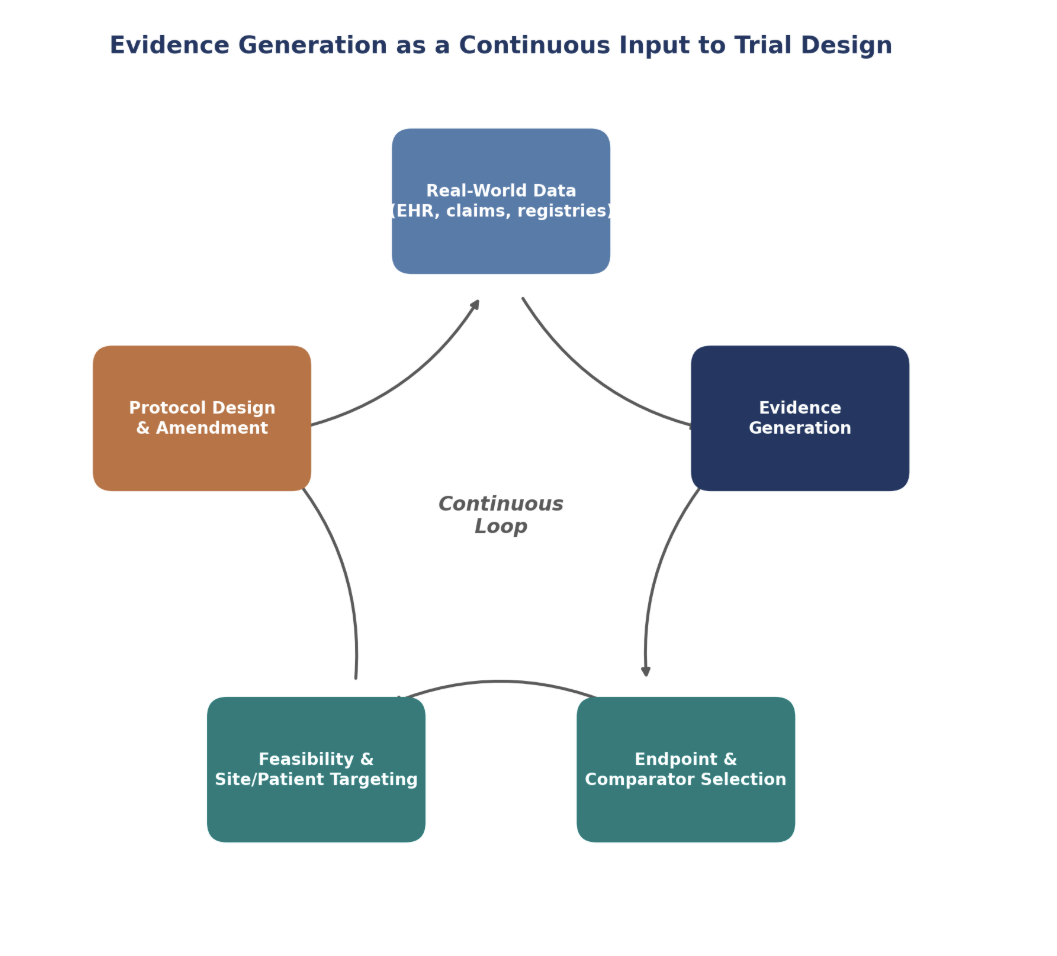 Fig. 1 — Evidence generation works best as a continuous input to trial design, not a one-time upstream report.
Closing the timeline gap starts with the data layer. NeuroDiscovery AI extracts trial-relevant variables symptom severity, functional and cognitive scores, prior treatment lines, imaging findings directly from clinical notes using models built specifically for neurology documentation, across a base of 6M+ patient records and 3M+ active patients spanning 1,000+ providers and 100+ clinical sites in 16+ U.S. states. That gives a protocol team a feasibility answer, an eligibility-criteria stress test, or a natural-history baseline in the time it takes to run a query, not the weeks a manual chart-review cycle typically takes.
The practical shift is where evidence generation sits in the trial design timeline: instead of a report that arrives after the protocol is drafted, it becomes a tool the design team can query directly while criteria are still open for revision.
Benefits
-
Faster protocol iteration. Feasibility and eligibility questions get answered against real-world data in days, not weeks, while a protocol is still in draft.
-
Sharper endpoint and comparator selection. Endpoints get chosen against how the disease actually presents and progresses in the real world, not solely against published literature.
-
Realistic feasibility estimates. Eligibility criteria get tested against an actual addressable population before they're locked, catching enrollment risk in review instead of mid-trial.
-
Fewer costly amendments. Design assumptions get evidence-checked upfront, reducing the number of assumptions that later require a formal amendment to correct.
-
Stronger regulatory positioning. Evidence-informed design aligns with the "quality by design" expectations in current ICH guidance, supporting a more defensible protocol from first submission.
Conclusion
Evidence generation improves clinical trial design when it happens early enough to change the protocol, not just explain it afterward. That requires treating evidence generation as part of the design process itself with real-world data infrastructure fast and detailed enough to answer a feasibility or endpoint question while the criteria are still open for revision, rather than after the protocol has already gone to sites.
To see how real-world evidence generation can inform your next protocol, explore.
FAQs
-
What is evidence generation in clinical trials?
Evidence generation is the process of producing reliable clinical evidence from trial data, real-world data, or both to support decisions like protocol design, endpoint selection, feasibility assessment, and regulatory submissions.
-
How does evidence generation improve clinical trial design?
When evidence is generated before a protocol is finalized, design teams can test eligibility criteria against a real addressable population, choose endpoints grounded in real-world disease presentation, and catch feasibility problems in review instead of mid-trial.
-
What real-world data sources support evidence generation?
Electronic health records, medical claims data, disease registries, and biomarker repositories are the most common sources, with note-level extraction from clinical documentation increasingly necessary to capture variables like symptom severity and functional status.
-
Why is evidence generation especially important in rare neurology trials?
Rare and progressive neurology indications often lack robust published natural history data and have small eligible populations, so a single miscalibrated inclusion criterion can meaningfully shrink an already-small addressable population.
-
What does "quality by design" mean for evidence generation?
It's the principle, reflected in ICH E8(R1) guidance, that quality and feasibility considerations including the evidence base behind them should be built into a clinical trial's design from the start, rather than assessed as a late-stage risk review.
